Saturday, 11 August 2012

Instruments for Measuring Gas Pressure


A) Manometer

The Manometer

1) A manometer consists of a U-tube containing a liquid such as mercury or water. It is usually used for measuring differences in gas or liquid pressure.
2) A sphymomanometer is a mercury manometer designed for doctors to measure the blood pressure of patients. 


B) Bourdon Gauge

Bourdon Gauge

1) A Bourdon gauge is used for measuring very high pressure such as the pressure of steam in a boiler or the pressure of compressed gases.
2) This movement is magnified by the lever arrangement which turns the cog-wheel that moves the pointer over a scale to indicate the pressure reading.

Applying Bernoulli's Principle


Bernoulli's Principle.

(Bernoulli's principle story)

1) Bernoulli's Principle states that the pressure of a fluid (liquid or gas) decreases at the region where the speed of fluid flow increases.


Relationship between speed of fluid flow and cross-sectional area.


Volume of fluid                       = A1v1
entering per second

Volume of fluid                       = A2v2
leaving per second              

The fluid is incompressible, so
A2v2 = A1v1

v2 = A1
v1    A2

2) To increase the kinetic energy, force is required to do work while flowing through the narrow section of the pipe.


Applying Archimedes's Principle


Archimedes's Principle.

(The Story of Archimedes' Palimpsest 2000)


Idea on Buoyant Force.

A less dense object floats in water.

1) The density of a object is less than that water since it contains air, thus is floats. 
2) Similarly, a large iron ship that has large space filled with air floats due to its lower density while a small solid iron sinks in water due to its higher density.

Idea of buoyant force.

3) For the object to float, its weight is balanced by the buoyant force (upthrust) acting upwards. If the buoyant force is larger than its weight, it bobs up to maintain the force equilibrium.


Applications of Archimedes' Principle in Everyday Life.

1) Ship
The ship

(a) The ship would sink to a certain level until its weight is equal to the buoyant force.
(b) To prevent this, a plimsoll line is marked on the hull of all ships to show the depths which are safe for them to navigate.

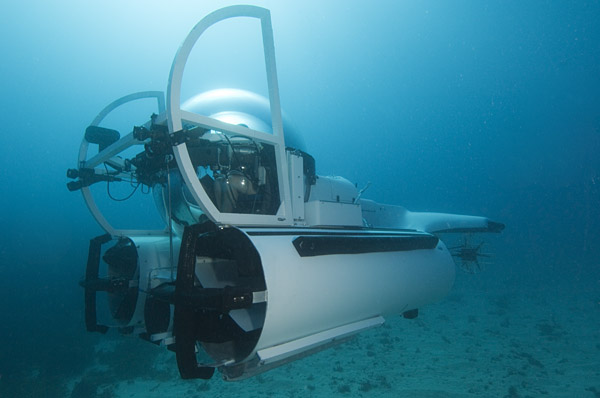
2) Submarine 
The submarine

(a) When afloat, water is driven out from the ballast tanks by compressed a larger buoyant force.
(b) The submarine can submerge to a depth where the buoyant to a depth where the buoyant force is equal to its weight.

3) Hot-air Balloons

(a) When the envelope of a balloon is filled with a gas of lower density than air such as hydrogen, helium or hot air, its weight decreases.
The total weight of the balloon = weight of the fabric + weight of the gas in the envelope.
(b) The balloon experiences a buoyant force = (volume of balloon) X (density of surrounding air) X g

The Hot-air balloons

(c) If the buoyant force is greater than the total weight of the balloon, it would be accelerated upwards by a net upwards force.

Hydrometer


Applying Pascal's Principle


Pascal's Principle.

Idea of Transmission of Pressure in a Liquid.

1) Hydraulic systems work by using liquids which are under pressure.
2) The principle of transmission of pressure in liquid can be illustrated by using a piece of apparatus.

Pressure is transmitted uniformly through water.

(a) The bulb is immersed in water and the piston is raised slowly to draw in water.
(b) The bulb is removed from the water tank.
(c) Then the piston is pushed hard enough to apply sufficient pressure to the water.
(d) It will be observed that water squirts with equal force from all the holes on the bulb.
(e) The shows that pressure applied to a liquid will be transmitted uniformly throughout the liquid.


3) Since the volume of a liquid is constant, the pressure applied is transmitted equally in all directions throughout the liquid. This idea of the transmission of pressure in a liquid is stated clearly in the Pascal's principle.


Applications of Pressure in Liquids


A) Public Water Supply System.


Public water supply system

1) In a public water supply system, water from a river or a dam is pumped to a water treatment plant.
2) Due to gravitational pull, water in the storage tank is maintained at a high pressure and this enables water to flow to the houses of the consumers which are lower.


B) The Walls of a Dam


The side view of a dam

1) The walls of a dam increase in thickness downwards.
2) A thicker wall is required to withstand greater pressure since water pressure increases with depth.


C) Fire Hose Used by a Fire-fighter 

Fire-fighter using a fire hose

1) A fire-fighter requires a fire hose for directing a water jet of very high  pressure to put out fire in a high-rise building.
2) To produce a pressurised water jet, the water is accelerated by an electric pump before flowing through the fire hose.


D) Sphygmomanometer for Measuring Blood Pressure


A doctor taking a patient's blood pressure

1) A doctor using a special mercury-filled manometer called a sphygmomanometer to measure the blood pressure of a patient.
2) On releasing the air in the cuff slowly, the doctor taken the maximum blood pressure (systolic) reading at the instant he/she hears the first sound of a spurt of blood.

Liquid Pressure Increases with Density


Liquid pressure increases with depth.

1) Holes are made at different heights on the side of a tall vessel. These holes are fitted with side tubes which are plugged up and the vessel is filled with water.
2) This shows that liquid pressure increases with depth.    

Liquid Pressure at the Same Depth Acts Equally in All Direction


Liquid pressure at the same depth acts equally in all direction.

1) On removing the plugs, it is found that water spurts our equally fast and reaches the same distance away from each hole.
2)This shows that the pressure at any point in a liquid acts equally in all direction.


Boucing Red Apple